
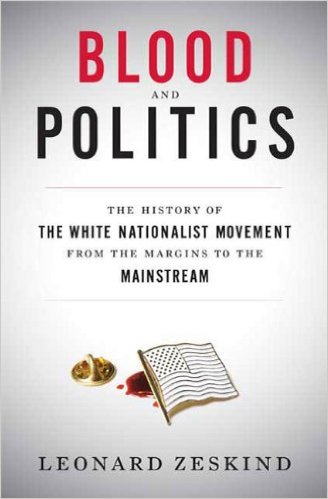
Blood and Politics: The History of the White Nationalist Movement from the Margins to the MainstreamAvailable Now

“Zeskind’s rigorously researched and eloquent book is a definitive history of white nationalism.” —Publishers Weekly

“Zeskind offers a well-placed warning ” —Kirkus Reviews

“Recommended for all libraries.” —Stephen L. Hupp, Library Journal

“Exhaustively researched, Blood and Politics is not only a brilliant account of the origins, modes of operation, collaborations, and internecine disputes of white supremacist, neo-Nazi, Holocaust-denier, and anti-Semitic groups in America, but alerts us to the fact that despite—or perhaps because of—significant improvements in race relations and changing demographic patterns, we are likely to witness a resurgence of their activities.” —Drew S. Days III, Professor of Law, Yale University, and former U.S. Solicitor General

www.BloodandPolitics.com

Kansas City Star on Leonard Zeskind

Posted on Sunday, May. 17, 2009
Kansas City Star

In history of radical politics, KC researcher connects dots
By STEVE PAUL


Leonard Zeskind hunches over, one eye clamped to a loupe, and inspects an old black-and-white photograph taped to his office door.
The picture and what he’s looking for tell a lot about what has been on Zeskind’s mind the past few decades.

Taken in 1967, it shows the funeral of George Lincoln Rockwell, the assassinated leader of the American Nazi Party. Standing among the two dozen grievers, next to a floral display in the shape of a swastika, is a thin young man with dark hair, wearing a jacket and narrow tie.

http://www.kansascity.com/entertainment/books/story/1202720.html?story_link=email_msg

Writing and Thinking Outside the Box

Writing and Thinking Outside the Box

The Zeskind Fortnight No. 16

by Leonard Zeskind

At the time I started writing the book that became Blood and Politics, many of the events described in its pages had not yet happened.  The murderous Weaver standoff had already ended and the Waco Branch Davidian compound had been reduced to ashes, but the militia movement had not fully blossomed and the federal building in Oklahoma City had not been bombed.  David Duke had won a majority of white votes in two statewide Louisiana elections, but California voters had not yet decided the Proposition 187 election campaign against immigrants.  The Soviet Union had collapsed and the post-World War Two era had ended, but I did not yet appreciate the full significance of what had happened.  Almost instinctively, I understood the "movement" character of the dozens (indeed, hundreds) of white supremacist groups, but I had not yet figured out how to write about them as a political and social whole.  My book was called, at that time, "Hate Mongers."  I still had at least one eye "in the box."

The "box" was a prism through which ordinary people, liberals and leftish anti-racists viewed and discussed white supremacists.  For most white people, racists and anti-Semites were simply kooks, inexplicable and slightly terrifying--particularly when violence and mayhem attended their local appearance.  Anti-racists had a slightly different vocabulary in which the terms "extremists" and "hate groups" loomed large.  The language and concepts of social psychology were employed to discuss these organizations and people.  All believed that racists and anti-Semites were poor and uneducated souls who blamed others for their problems while failing to take personal responsibility for their own situations.  To the extent political characterizations were used, white supremacists were thought to be defenders of the status quo, tools of conservative economic elites hoping to re-institute a regime of Jim Crow segregation.   Otherwise, they were irrelevant to considerations of social policy and civic society.

While my description of the "box" may be a bit of a caricature, it does not veer far from the constraints I felt when I first started writing this book.  My prose was stilted, full of the platitudes of liberal convention. The book's structure failed to hold the massive amount of detail I had in my hands.  There was no story: no beginning, middle and end.

On or about October 1, 1996 I broke the box.

It became obvious that the received wisdom was not wise at all.  With a few notable exceptions, the leaders of the movement who became characters in my book were almost universally well educated and middle class: an insurance company executive, a stock broker, a computer tech or two, several attorneys and salesmen, a chiropractor, and multiple PhDs--including an infamous physics professor.  They were obviously motivated by ideological conviction, and the movement they built was shaped in their image.  Calling them "haters" and "extremists" did not and could not work for me.

In their aggregate, they were committed to overturning American society rather than seeking to return it to some previous era.

These were nationalists, white nationalists, operating in a political fashion on the terrain of history.  Race and theology, nationalism and national identity, history and geo-politics--social constructs all--became the terrain upon which I wrote this book.  As such I abandoned the usual discourse with which this topic is discussed. The so-called paranoid style, scapegoating and other such ideas simply did not fit the facts as they presented themselves.

There are multiple other places where Blood and Politics: The History of the White Nationalist Movement from the Margins to the Mainstream breaks from the conventional wisdom of the time.  I can not point them all out here, but many of the most important events occurred during the fifteen years that have elapsed since I began this project.  I tried to shape these multiple strands into a compelling and readable story, and I can not replicate that process here in less than fifteen hundreds words.  I wanted to write a book, with a new and different analysis.  I would urge you to read it and decide for yourself if I succeeded.

TZF

As John Demjanjuk Awaits Deportation,


As John Demjanjuk Awaits Deportation,
Remembering the Story of Nazi War Criminals and the United States

The Zeskind Fortnight No. 15
April 14, 2009

John Demjanjuk, the Ukrainian-born retired autoworker charged repeatedly with war crimes, has asked a federal appeals court in Ohio to stop his deportation to Germany. First stripped of his United States citizenship in 1981 for lying about his Nazi past upon entry to this country, he was deported to Israel in 1986, convicted and sentenced to death, but released on a decision by the Israeli Supreme Court.  He returned to the USA in 1993 and had his citizenship restored.  Demjanjuk’s citizenship was revoked again in 2002, after further investigation by the Justice Department confirmed his role at the Sobibor camp.

Throughout Demjanjuk has claimed that he was an ordinary soldier in the Soviet Army who after being captured by the Germans was held as a prisoner of war.  Documents from the Soviet Union showing otherwise, he contended, were forged.  He is now charged in Germany with assisting in the murder of 29,000 victims at the Sobibor death camp in the Lublin district of Poland.

Between 200,000 and 250,000 Jews died at Sobibor, according to The Holocaust Encyclopedia.  After May 1942, this camp became one of several where carbon monoxide produced by a diesel motor was pumped into gas chambers, poisoning the inmates in about thirty minutes. In October 1943, a revolt by 600 inmates at Sobibor broke through the wire fence after attacking the guards and the weapons arsenal.  Most of the escapees were killed in the mine fields that surrounded the camp, and others died at the hands of Polish fascists and thieves.  Thirty five survived the war, however, to tell their story. After the rebellion, the Nazis razed the camp, but they could not erase the memory of what they had done.  Nevertheless, Holocaust deniers and others have tried to rewrite this history in an attempt to either exonerate Hitler’s National Socialism, or to prettify the United States post-war record with war criminals.

In 1990, Pat Buchanan, a Reagan speechwriter who ran for president three times before settling into his current position as a television commentator, wrote that “diesel engines do not emit enough carbon dioxide to kill anybody.” It was an absurd claim, which helped earn him the sobriquet, “spokesman for war criminals in the United States,” from Nazi-hunter Allen Ryan, Jr.  Over a ten year period, Buchanan wrote multiple times in defense of the Ukrainian-born camp guard and in opposition to the Office of Special Investigations (OSI).  Created in 1979 by legislation drafted by Congresswoman Elizabeth Holtzman, the OSI is a Justice Department agency that has investigated war criminals living in the United States. Among other complaints, Buchanan argued that by giving credence to documents provided by the KGB, the OSI was using faulty evidence. In this regard, Buchanan’s campaign against the OSI has been a continuation of his own Cold War politics.

Prior to OSI’s founding, the United States government’s history with Nazi war criminals was not pretty. American prosecutors at the Nuremburg trials helped bring a modicum of justice to the post-war world.  But under President Harry Truman, the Army Counterintelligence Corps and the CIA protected, financed and used Nazis and war criminals in their own intelligence operations.

Read more...